Ktunaxa place names
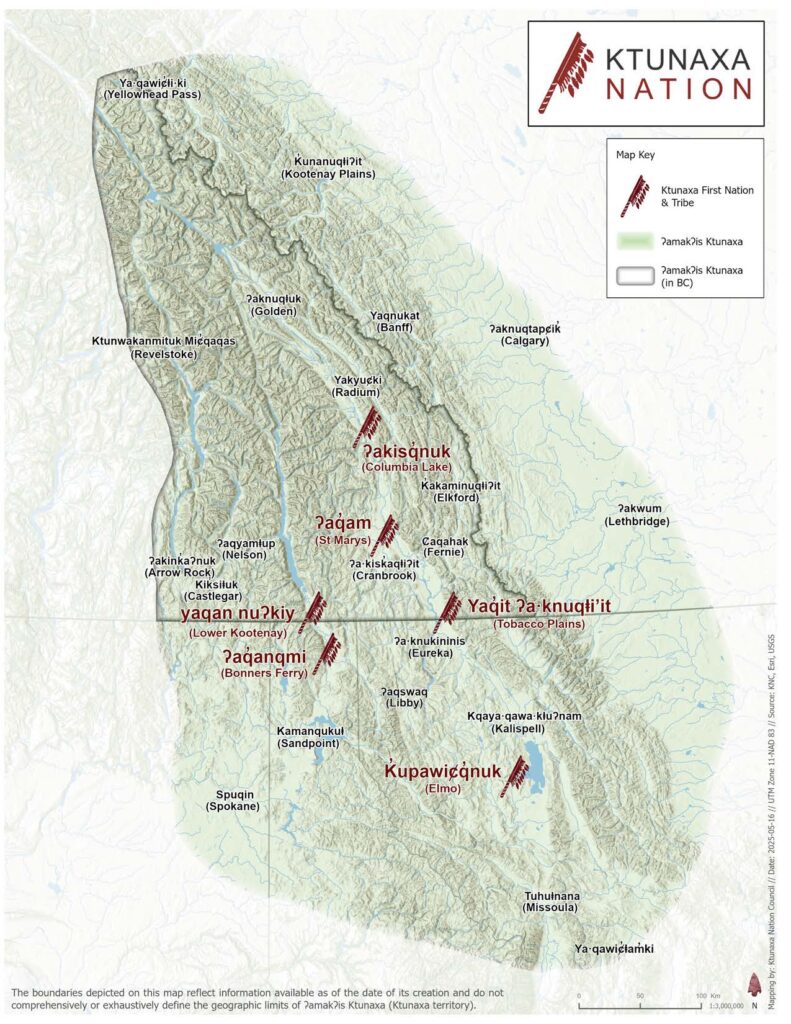
The boundaries depicted on this map reflect information available to us as of the date of its creation and do not comprehensively or exhaustively define the geographic limits of ʔamakʔis Ktunaxa.
ʔakink̓aʔnuk
Arrow Rock
Yaqnukat
Banff
ʔaq̓anqmi
Bonner’s Ferry
ʔaknuqtapȼik̓
Calgary
Kik̓siⱡuk
Castlegar
ʔakisq̓nuk
Columbia Lake
ʔa·kisk̓aqⱡiʔit
Cranbrook
K̓akaminuqⱡiʔit
Elkford
K̓upawiȼq̓nuk
Elmo
ʔa·knukininis
Eureka
Ȼaqahak
Fernie
ʔaknuqⱡuk
Golden
Kqaya·qawa·kⱡuʔnam
Kalispell
K̓unanuqⱡitʔit
Kootenay Plains
ʔakwum
Lethbridge
ʔaqswaq
Libby
yaqan nuʔkiy
Lower Kootenay
Tuhuⱡnana
Missoula
ʔaqyamⱡup
Nelson
Yakyuȼki
Radium
Ktunwakanmituk Miȼqaqas
Revelstoke
Kamanqukuⱡ
Sandpoint
Spuqin
Spokane
ʔaq̓am
St. Mary’s
Yaq̓it ʔa·knuqⱡi’it
Tobacco Plains
Ya·qawiȼⱡi·ki
Yellowhead Pass
ʔamakʔis Ktunaxa
Our culture and identity are rooted in our land.
Ktunaxa (pronounced ‘k-too-nah-ha’) people have occupied the lands adjacent to the Kootenay and Columbia Rivers and the Arrow Lakes of British Columbia, Canada for more than 10,000 years.
ʔamakʔis Ktunaxa, (our traditional territory) covers about 70,000 square kilometres (27,000 square miles) within the Kootenay region of southeastern British Columbia.
Ktunaxa place names, stories and songs passed down from untold generations are a rich cultural heritage written across our homeland.
Historically, ʔamakʔis Ktunaxa included parts of Alberta, Montana, Washington and Idaho.
For thousands of years, we enjoyed the natural bounty of the land, moving throughout ʔamakʔis Ktunaxa to follow vegetation and hunting seasonal cycles.
We obtained all our food, medicine and material for shelter and clothing from nature – hunting, fishing and gathering throughout our territory, across the Rocky Mountains and on the Great Plains of both Canada and the United States.
We fished for salmon on the Kootenay and Columbia waterways, and hunted buffalo in the foothills of the Rockies.
European settlement in the late 1800s led to the establishment of Indian Reserves (starting in 1887) and the residential school system.
Hydroelectric dams on the Columbia River blocked salmon and removed it as one of our primary food sources from the 1930s onward. The Bush Fire Act of 1874 made it illegal to apply fire to the landscape, which stopped Ktunaxa ancestors from practicing beneficial burning in the ancient fire-maintained landscapes of the Rocky Mountain Trench.
Now, Ktunaxa First Nations and Kootenay Tribes (based in Montana and Idaho) are rebuilding self-governance, revitalizing our language, and bringing our values and stewardship principles forward as we assert our right and responsibility to care for ʔa·kxam̓is q̓api qapsin (all living things) in ʔamakʔis Ktunaxa.